Performance Creative Killed My Inner Artist
I have a confession to make: Somewhere along the lines in this content-creation life, I stopped creating out of a need to express, and I started creating out of a desire to impress.
Even now, as I sit here writing this, there’s a little voice telling me: Stop. Make it prettier. Wrap it up in a neat graphic. Format it. Choose the perfect font. Turn it into something Instagrammable.
It’s a habit I’ve been working to break: the need to be first in, best dressed, so to speak. The tendency to jazz up what I have to say in just the right clothes, hoping it might catch someone’s eye. But the truth is… it kills my creativity.
In recent years, my over-indexing on production has slowly strangled the artist in me that just wants to write and share and move on. I would holding things back if I didn’t think they were “ready” or I hadn’t decided what font or background colour to use, what format, does it need a song, a hook? Every digital button pressed, every decision chipped away at the things I actually wanted to say... I grew more and more frustrated watching other people create so freely meanwhile feeling like I was sitting on my own hands.
Why couldn’t I just… share?
And then I realized I was trying to make content, rather than express. And I felt the difference immediately. So I started to write...
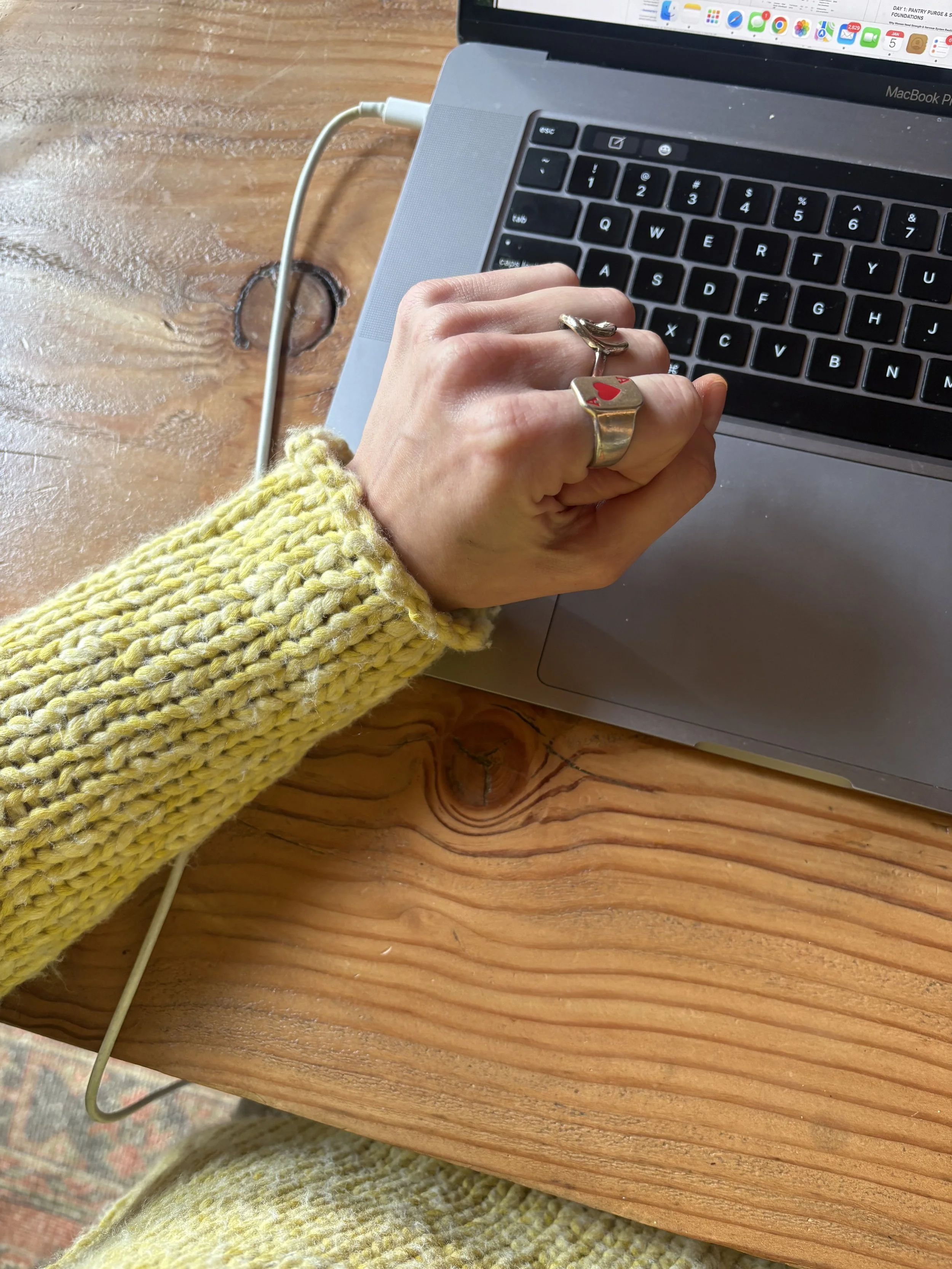
See, I’ve always loved to write. Before I ever drew, painted, designed, coded — I wrote. As a kid, my journals were always hardcover, always filled. One had mirrored green circles all over it, and I still remember looking at my blurry reflection in its poor-quality reflection before dishing about boys and dramatizing my days in its pages.
Later, my family had this clunky gray IBM laptop — a brick of a thing — and on it, I wrote stories you wouldn’t expected from a 12-year-old girl: I was obsessed with Michael Crichton and thrillers then, so I crafted medical dramas with metaphysical twists and turns. I loved slipping into the persona of a middle-aged surgeon, a man carrying deep heartache, uncovering truths about his late wife while performing surgeries in cold, sterile rooms. The stuff most little girls imagine, no? (lol). Even my illustration-school thesis at age 22 turned into a 188-page sci-fi novel, cosplaying as a design project.
Looking back, I’ve always expressed with writing first. It’s always felt like my safe space — maybe because I’ve always believed words carry their own weight without needing anything else. The problem is, somewhere along the way, I stopped trusting that. I started believing my words weren’t enough on their own — that they had to be dressed up, styled, packaged, and produced before they were worth sharing. Maybe it was art school, maybe it was societal pressure from our material world, maybe it was me thinking something so pure and natural had to be more complicated, or maybe it’s that I’m a visual person who loves beauty. But somewhere along the way, it became about the presentation. Not the expression.
In 2014, I was told by my first career-job boss that I have a tendency to think execution first when I haven’t fully established a fully-baked core message yet. And this confused me because I felt like I had just spent four years learning how to package messages and make things look good — learning contrast, repetition, alignment, positioning, — only to be told that the root idea was most important. Foolishly at the time, I did not believe him and kept up with my tendency to visualize the vehicle used to deliver something before than the content of said car. Not because the message isn’t important, but because I think deep down I know that beauty and design and art and experience are powerful tools that trigger us to care, to learn, or to remember something…
It’s literally in my makeup as a human — how I’m wired. My chart practically screams it: I’m a Libra rising who feels at home in balance and aesthetics, a Taurus moon who craves tactile, grounded beauty, a Sagittarius sun who wants it all to mean something. My Human Design as a Projector makes me sensitive to patterns, details, and the harmony of it all — I can’t help but notice when something’s off, or imagine how it could be better. Beauty for me isn’t just what something looks like — it’s what it feels like, what it evokes, what it unlocks in us. I see it in everything, and I want to bring it to everything.
But somewhere along the lines, I started letting the beauty of the container drown out the heart of what it was meant to carry.
In the process of living my shiny-object syndrome life, I stopped valuing my raw expression. My real art. Not the polished pixels I turn into logos or graphics. And that is what I’ve been unlearning recently and it feels so good to let go.
So if you needed the reminder: You don’t need to bolster the beauty of what you make. The beauty is already there. You just have to share it.